LOS ANGELES — Mickey Rooney, the biggest box office star in America before he was old enough to vote, sat before the United States Senate at the age of 90 and told the country he had been a prisoner in his own home, starved, controlled, and too terrified to ask for help.
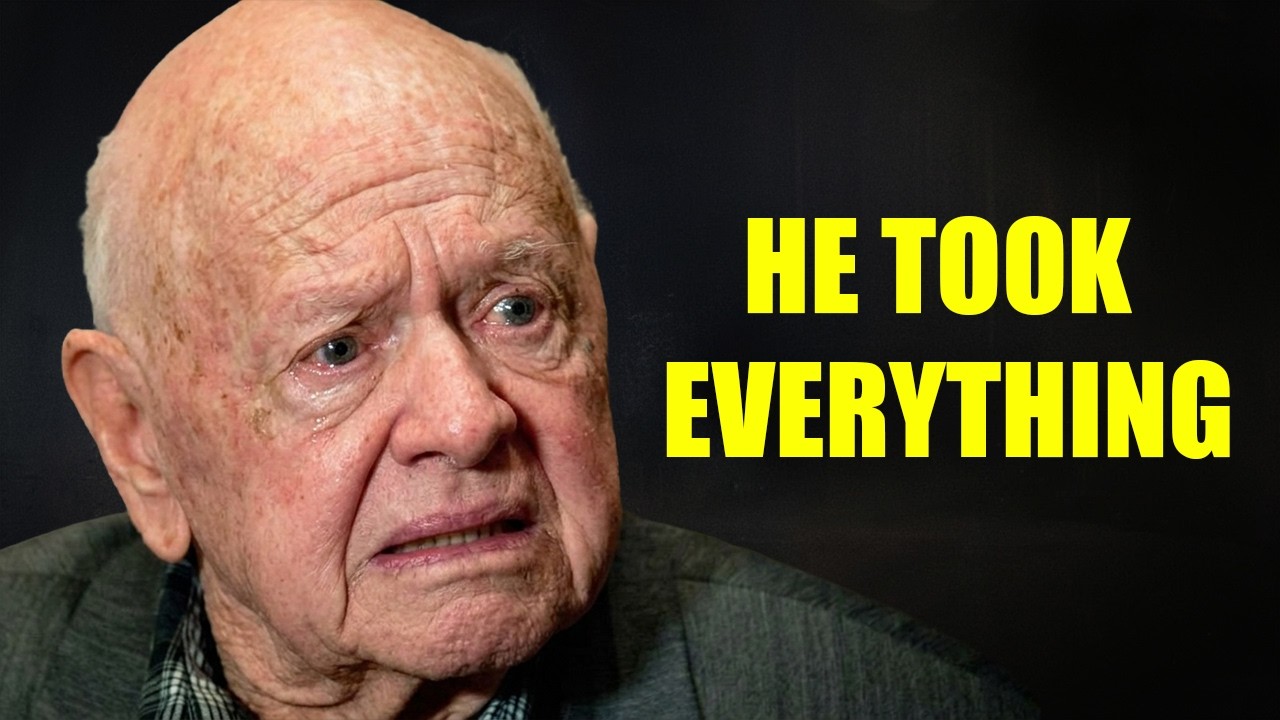
The testimony, delivered on March 2, 2011, to the Senate Special Committee on Aging, capped a decade of financial exploitation and psychological abuse that stripped one of Hollywood’s most enduring legends of nearly everything he had earned across a 90-year career.
Rooney told lawmakers he had felt “trapped, scared, used, and frustrated.” He said that above all else, he had felt helpless. He said he had suffered silently for years, unable to find the courage to ask for help.
This was not a scripted studio appearance. This was the man who played Andy Hardy, the most wholesome teenager in American film history, admitting on the record that his own family had turned him into a hostage.
Born Joseph Yule Jr. in Greenpoint, Brooklyn, on September 23, 1920, Rooney was the son of a Scottish vaudeville comedian and a Kansas City chorus girl. Neither had money.
Neither had stability. What they had was a stage act and a baby who would not stay in the wings.
At just over a year old, he crawled directly into his parents’ act mid-performance in front of a live audience. Nobody trained him to do that. It was the first sign of something that would define his entire life.
He did not simply enjoy the spotlight. He seemed unable to survive without it.
His parents split in 1924. His mother took him to Hollywood the following year, running a tourist home to pay rent while she pushed her son into the film business one audition at a time. By 1927, he was headlining his own series of 78 comedy shorts, playing a character named Mickey McGuire.
He legally adopted the character’s name to avoid a licensing dispute.
By 1934, Metro-Goldwyn-Mayer signed him to a long-term contract. What followed was not just success. It was domination.
He played Puck in a Shakespeare adaptation and proved he could act. He debuted as Andy Hardy in 1937, a role that would define small-town American values for an entire generation across 16 films.
That same year, he was paired for the first time with a young singer named Judy Garland, beginning a partnership across 10 films that Hollywood still talks about. By 1939, he had an Academy Juvenile Award, his first Best Actor nomination at 19 years old, and was officially the number one box office star in the United States, ahead of every adult actor working in Hollywood.
Behind the wholesome image the studio sold, something else was already forming. Studio boss Louis B. Mayer personally policed his public behavior because Rooney’s real life looked nothing like Andy Hardy’s.
There was gambling, heavy spending, and a growing pattern that would follow him for the rest of his life.
In 1942, Rooney married Ava Gardner. It lasted about a year. It was the first of eight marriages and it set a pattern nobody wanted to admit was a pattern.
Fast romances, fast divorces, alimony, child support, money going out the door faster than it came in.
 Then came World War II. Rooney served in the Army’s Special Services Division, performing for troops across Europe, and earned a Bronze Star. But when he came home in 1946, something had changed that had nothing to do with the war.
He was an adult now, 5’2″, and Hollywood did not know what to do with an adult Mickey Rooney.
The parts dried up. What followed was over a decade of financial freefall. Divorce from Betty Jane Phillips, marriage to Martha Vickers, divorce from Martha Vickers, marriage to Elaine Devry, divorce from Elaine Devry.
Each one came with legal obligations. None of them came with a plan.
By 1962, it caught up with him completely. Rooney filed for bankruptcy and admitted publicly that he had gone through 12 million dollars. A fortune, gone.
But the detail that matters most for everything that happened later is this. The contracts Rooney signed during his golden years at MGM were written before the modern residual system existed. No royalties for television reruns.
No syndication payments. No home video income. The man who once outsold every actor in America had no ongoing revenue stream from the work that made him famous.
Once the movie offers stopped, so did the money.
In 1966, tragedy struck again. His wife, Barbara Ann Thomason, was found dead in their home, killed in a murder-suicide by her lover. Rooney remarried within months to her close friend.
That marriage lasted 100 days.
By the time he married his eighth and final wife, Jan Chamberlain, in 1978, Rooney had been through seven marriages and multiple bankruptcies of trust as much as money. This one would last longer than all the others combined. For a while, it looked like stability had finally found him.
Then, in 1979, Rooney did something almost nobody’s career survives doing twice. He came back. “Sugar Babies” on Broadway, “The Black Stallion,” the television movie “Bill,” which won him an Emmy and a Golden Globe.
In 1982, the Academy gave him an honorary Oscar for lifetime achievement. Mickey Rooney had rebuilt himself from nothing twice. He should have been set for the rest of his life.
He was not.
In 1998, two of Jan Chamberlain’s adult sons from a previous marriage began helping around the house. One of them, Christopher Aber, started as a personal assistant. He booked travel.
He managed red carpet appearances. On paper, it looked like exactly what an aging star needed. Someone to handle the details.
 But by 2001, Christopher Aber had gone far beyond handling details. He named himself an owner and signatory on every one of Rooney’s bank accounts, personal and business, including the accounts of Densmore Productions, the company that processed Rooney’s acting fees, appearance income, and licensing deals. That single decision handed one man complete control over the finances of a 90-year-old screen legend.
Aber moved fast to make sure nobody could check his work. He set up a private post office box under his own name and rerouted every piece of Rooney’s financial mail there. Bank statements, tax notices, personal checks.
None of it reached the house anymore. Rooney had no way to see what was happening to his own money because he never saw the paperwork at all.
Between 2002 and 2007, Aber applied for at least 10 high-limit credit cards in the name of Densmore Productions, several of them American Express accounts, all without Rooney’s knowledge. He used them to fund a lifestyle that had nothing to do with a 90-year-old man living quietly at home. He did not pay the balances on time.
The interest piled up. The penalties piled up. And because the accounts were tied to Rooney’s company, the debt legally belonged to Rooney, not to Aber.
By 2008, the unpaid taxes and mounting credit debt had created a genuine crisis. Delinquent tax liens, real risk of losing the house, and Rooney did not know any of it because the one man managing his money was the same man hiding it from him.
But that was not even the worst part.
In April of 2009, Rooney’s other stepson, Mark Aber, and his wife, Charlene, moved into the Westlake Village home. What they found alarmed them enough to start keeping records. Verbal abuse, intimidation, a 90-year-old man who seemed frightened in his own living room.
By 2010, Christopher Aber had a new form of leverage, the tax debts he himself had created. He reportedly threatened Rooney with foreclosure and the loss of his SAG-AFTRA health insurance if Rooney refused to keep working. According to court petitions, food and medication were withheld to pressure him into compliance.
Rooney sank into clinical depression.
According to sworn statements gathered during the conservatorship proceedings, whenever Christopher Aber entered the house unannounced, Rooney would experience uncontrollable panic attacks, severe enough that he lost control of his own body. This was a man who had once performed for two million soldiers overseas, a man who had faced down live audiences his entire life, reduced at 90 to pure animal terror at the sound of his stepson’s footsteps.
On February 14, 2011, fearing that Aber might try to physically remove Rooney or force him to sign documents, Rooney’s legal team petitioned the court for emergency protection. A judge granted a temporary conservatorship and issued a restraining order requiring Aber to stay at least 100 yards away from Rooney, his home, and his caretakers.
Less than a month later, a frail 90-year-old Mickey Rooney traveled to Washington D. C. and sat before the Senate Special Committee on Aging.
Three weeks after that, on March 25, a judge handed permanent control of Rooney’s estate to a court-appointed conservator, attorney Michael Augustine.
Augustine later testified that Rooney was so broke he could not even afford to buy his wife a bouquet of flowers for Valentine’s Day. Four hundred thousand dollars in assets were confirmed missing from his accounts.

In September of that year, Augustine’s legal team filed a civil elder abuse lawsuit against Christopher and Christina Aber, alleging fraud, breach of fiduciary duty, and misappropriation of Rooney’s own name and likeness.
In October of 2013, the court entered a judgment against the Abers for $2,865,000. A clear legal acknowledgement of a decade of financial abuse. Almost immediately, Christopher and Christina Aber filed for Chapter 7 bankruptcy, claiming they had no assets left to pay a single dollar of it.
Rooney’s legal team refused to let it end there. Under federal bankruptcy law, debts created through fraud or breach of fiduciary duty cannot simply be erased. A court agreed the judgment survived.
His attorneys then went after the Abers’ homeowners insurance policy directly, triggering a separate federal lawsuit that was still unresolved when Rooney died. Even winning in court did not mean getting paid.
In June of 2012, after 34 years of marriage, Jan Chamberlain formally separated from Rooney and signed away any future claim to his estate. Rooney moved in permanently with Mark and Charlene, the stepson and daughter-in-law who had rescued him.
On March 11, 2014, Rooney signed his final will. He disinherited Jan Chamberlain. He disinherited all eight of his biological children.
He left everything, what little remained, to Mark.
Less than a month later, on April 6, 2014, Mickey Rooney died at home in North Hollywood at the age of 93. One of the most famous entertainers in the history of American film left behind exactly $18,000.
Even then, the betrayal was not finished. Jan Chamberlain and Christopher Aber tried to legally block his burial, fighting to have him interred in a private family plot in Westlake Village, right next to a space reserved for Jan. It took an emergency court hearing to stop them.
Rooney had made clear he wanted to rest among his Hollywood peers, and eventually he was laid to rest at Hollywood Forever Cemetery.
In May of 2014, seven of his eight biological children joined Jan Chamberlain in challenging his final will, claiming undue influence. It took over a year, until August of 2015, for the court to dismiss every challenge and confirm the will exactly as Rooney had written it.
Mickey Rooney spent nearly 90 years in front of an audience. He was the biggest star in America before he could vote. He rebuilt his career from nothing, not once, but twice.
And in the final decade of his life, the man who represented American wholesomeness to millions of moviegoers was reduced to fear, isolation, and poverty inside his own home by people who were supposed to protect him.
His decision to testify before Congress did not just expose what happened to him. It changed how elder financial abuse cases are prosecuted in California, and it inspired a pro bono legal project that still protects vulnerable seniors today.
Rooney once said that if elder abuse could happen to him, it could happen to anyone. He wanted people to know they deserved better. At 90 years old, with almost nothing left to his name, Mickey Rooney used the last of his platform not to save himself, but to warn everyone else.
