For millions of television viewers who grew up gathered around the glow of a console set, the Cartwright family of the Ponderosa ranch represented something far more enduring than mere weekly entertainment, and the quiet departure of its eldest son remains one of the most emotionally complicated farewells in the history of American broadcasting.
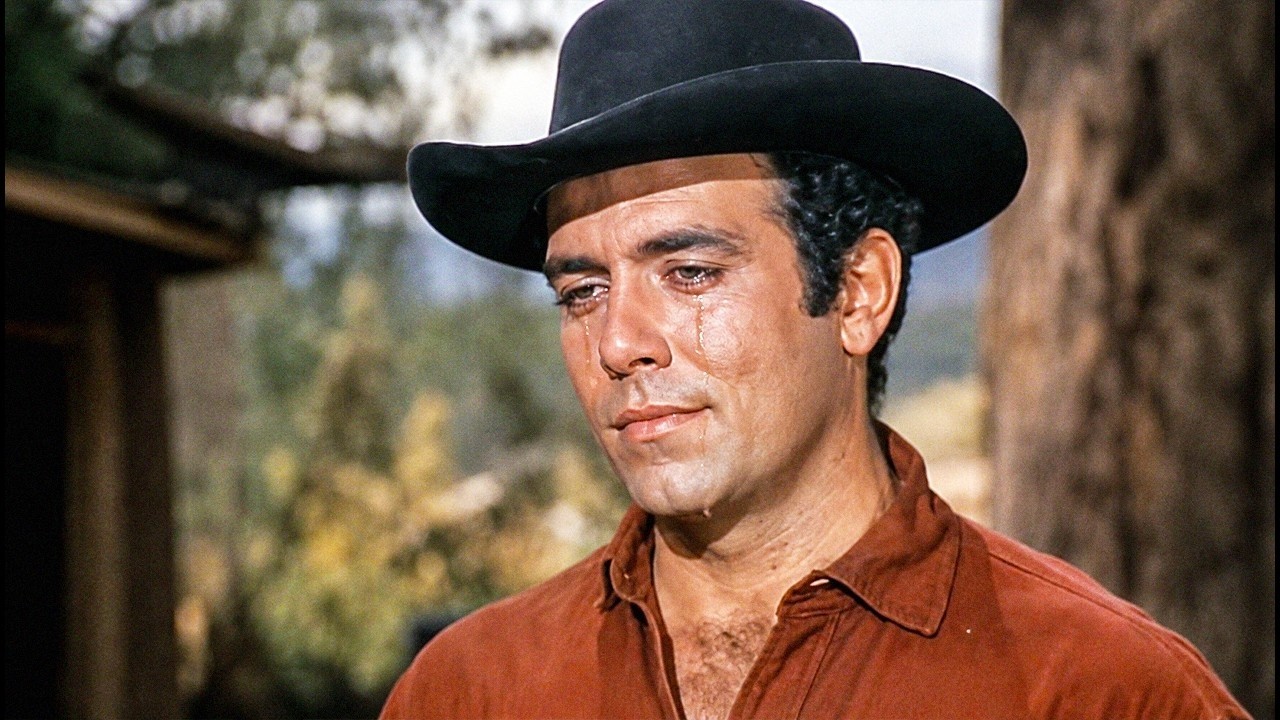
Pernell Roberts, the tall, commanding actor who brought Adam Cartwright to life with a rare blend of intellect and restraint, walked away from the biggest hit on television at the absolute peak of its cultural dominance, and the final episodes in which he appears now carry a weight that audiences in the early 1960s could not possibly have understood.
Bonanza premiered in 1959 and almost immediately redefined what a Western could be, shifting the genre away from lone gunslingers and toward a family saga built on loyalty, land, and legacy. The Cartwrights were not merely characters; they became fixtures in American living rooms, a weekly ritual watched by tens of millions of households.
At the center of that family stood Adam, the eldest son, the educated one, the brooding figure dressed in black who seemed to carry the moral weight of the entire ranch on his shoulders. Roberts played him with a quiet authority that made the character feel genuinely adult in a landscape often populated by archetypes.
But behind the cameras, a very different story was unfolding, one that would eventually force one of the medium’s most recognizable stars to make a decision that stunned the industry and baffled his own fans.
Long before Bonanza turned him into a household name, Roberts had pursued a life far removed from the dusty backlots of Hollywood. Born in Waycross, Georgia, he developed an early and consuming passion for music, theater, and the works of William Shakespeare, disciplines that demanded discipline, training, and intellectual engagement.
He served in the United States Marine Corps before committing himself fully to acting, and by the 1950s he had built a respected stage career, earning critical praise for powerful performances in classical productions including Macbeth and Romeo and Juliet. His rugged presence and resonant voice soon attracted the attention of television executives.

Hollywood quickly cast him as one of the most recognizable faces in Westerns, and when Bonanza exploded into a worldwide sensation, it appeared that Roberts had achieved everything an actor could want. The reality, according to those who worked alongside him, was far more complicated.
Roberts began to feel trapped inside the very role that had made him famous. While audiences adored Adam Cartwright, the actor believed the character never truly evolved, remaining frozen in a pattern that felt increasingly demeaning to a performer of his training and ambition.
The sophisticated eldest son, in Roberts’ view, was still written like a child constantly seeking his father’s approval, a dynamic that repeated itself season after season with little variation. To a serious theater actor hungry for deeper material, the scripts slowly became unbearable.
Behind the scenes, tensions grew steadily as Roberts argued with writers and producers, pushing for more intelligent stories and meaningful themes. He believed television could be more than simple entertainment, that it could challenge its audience rather than merely soothe it.
The network, however, had no interest in changing a formula that was generating millions of dollars in revenue and dominating the ratings week after week. The conflict was fundamental, and it was irreconcilable.
 Eventually, despite the fame, the money, and the extraordinary success, Roberts made the shocking decision to walk away at the height of Bonanza’s popularity, a choice that few actors in the history of the medium have ever been willing to make.
Watching his final episode today carries a completely different emotional weight, because knowing what was happening behind the scenes, you can almost sense the end coming. The farewell was not dramatic in any conventional sense.
Adam was not killed off in some tragic showdown, nor was he written out through a scandal or a sudden death. Instead, the writers quietly explained that he had gone away on business and later traveled overseas, leaving the door open in case Roberts ever chose to return.
But he never did, and that silent disappearance somehow makes the moment even sadder, a departure without closure, a character simply fading from the narrative as though the Ponderosa itself had quietly let him go.
Off camera, Roberts carried private heartbreaks of his own, including failed marriages and the devastating loss of his only son years later, personal tragedies that he largely kept away from the public eye while continuing to guard his independence fiercely.
Yet through all the struggles, he remained committed to living life on his own terms, a principle that guided nearly every major decision of his career and ultimately defined his legacy in an industry that rarely rewards such stubborn integrity.

After leaving Bonanza, Hollywood punished him for a time, and work became scarce, a familiar fate for actors who defy the powerful machinery of network television. But Roberts never publicly admitted regret, even as the offers dried up.
Years later, he finally found success again in Trapper John, M. D. , a role that earned him renewed respect and proved he was far more than just a cowboy in a black hat, a performer capable of warmth, humor, and range.
By the time Pernell Roberts passed away in 2010, he had become something rare in Hollywood, a man who willingly gave up enormous fame to protect his artistic freedom, a decision that cost him dearly but never broke him.
And that is why Adam Cartwright’s final Bonanza appearance still feels so haunting today, not simply because it marked the end of a beloved character, but because it captured a moment when a talented actor chose himself over the safety of television stardom.
He rode away from the Ponderosa for good while the rest of the world wondered why anyone would ever leave paradise behind, and in that quiet, unresolved exit lies one of the most poignant stories in the history of American television.
