The bright California sun had long since set on the dusty backlots where she once rode, but the echo of hooves and the crack of a rifle still linger in the memory of American television. Gail Davis, the woman who taught a generation of girls that they could be the hero, lived a life that was far more complex than the simple, optimistic world she inhabited on screen. Behind the braided hair and the steady gaze of Annie Oakley lay a story of shattered dreams, a career that became a gilded cage, and a personal life that remained shrouded in secrecy until the very end.
For millions of Americans in the 1950s, Gail Davis was not just an actress; she was a revelation. In an era when Western heroes were exclusively male, she rode onto the small screen with a confidence that defied convention. She was a crack shot, a fearless rider, and a problem-solver who didn’t need a man to save her.
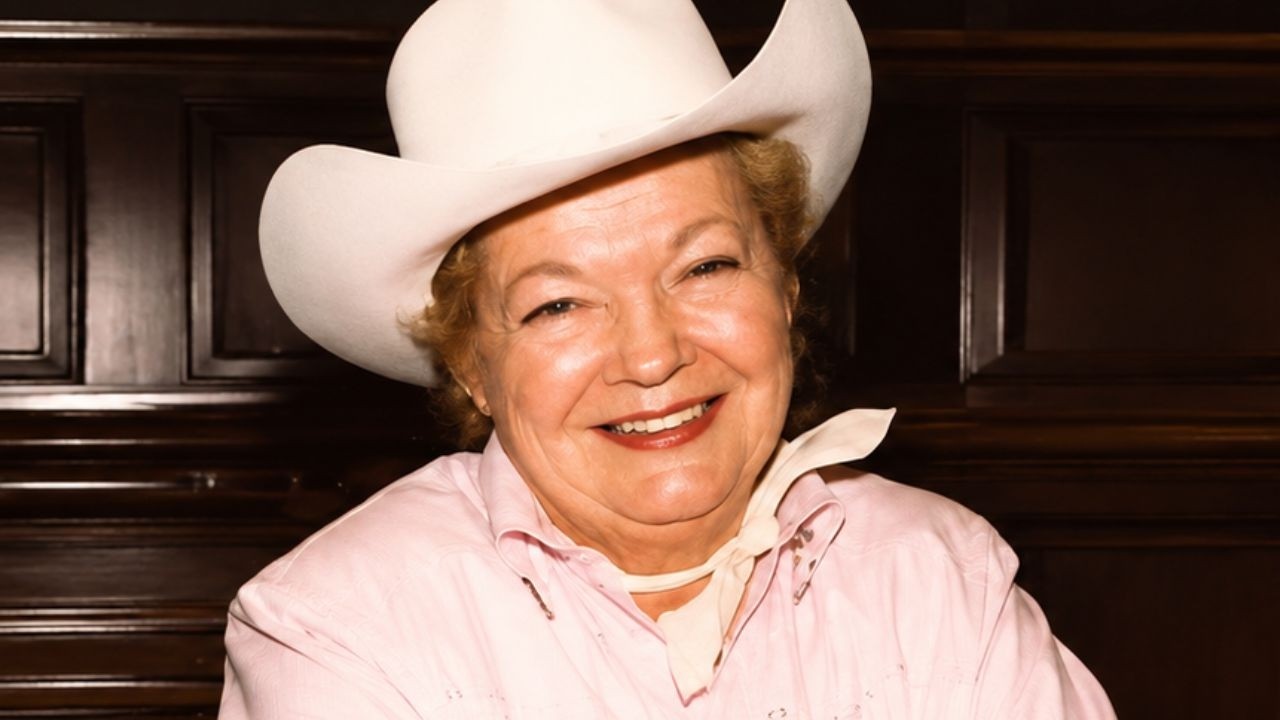 This was a radical image for the time, and it resonated deeply with young viewers, particularly girls who had never seen themselves reflected in the role of the daring protagonist. The character of Annie Oakley was a quiet revolution, broadcast into living rooms across the nation.
But the woman behind the icon was born Betty Jean Grayson in Little Rock, Arkansas, in 1925. Her childhood in the conservative South was a study in contrasts. She was raised in a stable, educated family, the daughter of a physician, yet she was a self-described tomboy who preferred the outdoors to the parlor.
She learned to ride horses and shoot rifles at a young age, skills that would later define her career but were, at the time, simply part of a childhood spent in a world of traditional values. This foundation of discipline and propriety would follow her to Hollywood, where she would navigate an industry notorious for its excesses with a quiet dignity that was almost unheard of.
Her initial ambition was not the dusty trail of the Western frontier but the bright lights of the musical stage. She dreamed of a career in musical theater, a far cry from the world of cowboys and cattle rustlers. However, post-war Hollywood saw something different in the athletic young woman.
The studios, particularly under the influence of singing cowboy Gene Autry, recognized her unique skill set. She could ride, she could shoot, and she possessed a wholesome, all-American look that was perfect for the booming Western genre. Her own dreams were pushed aside as she was molded into a new kind of star, a process that began with the changing of her name from Betty Grayson to Gail Davis.
The early years in California were a whirlwind of low-budget films. Gail and her first husband, Bob Davis, had moved west with hopes of making it in the industry. While she worked her way through more than thirty features in just a few years, the marriage began to fray under the relentless pressure of the production schedule.
The couple divorced in 1952, just as her star was about to ascend to its peak. The dissolution of her marriage was a private affair, handled with the same discretion that would characterize the rest of her personal life, but it marked the first crack in the facade of the perfect, happy cowgirl.
The creation of Annie Oakley in 1954 was a gamble that paid off spectacularly. Gene Autry, recognizing a gap in the market for a female hero, initially had his doubts about casting Gail. But she was relentless, showing up to a meeting in full character with braids and freckles, and she won the role.
 The show was an instant hit, running for 81 episodes and turning Gail into a household name. She was no longer just a supporting player; she was the center of her own universe, a woman who could outshoot any man and still maintain a sense of grace and calm. The show was a phenomenon, spawning merchandise, comic books, and a wave of fan mail from adoring children.
Yet, this immense success came at a profound personal cost. The role that made her famous also trapped her. The grueling production schedule was relentless, with Gail often filming three episodes a week, waking before dawn to braid her own hair and working until late into the night under the harsh California sun.
It was during this period that her relationship with Gene Autry deepened beyond that of a professional partnership. The man who had created her career became a central figure in her private life, a secret that was kept largely out of the press, adding another layer of complexity to her carefully constructed public persona.
The affair with Autry was a double-edged sword. He was her mentor, her boss, and her lover, blurring the lines between her personal and professional existence. While it may have provided a sense of connection, it also further cemented her identity as a product of his creation.
She was not just Gail Davis; she was Gene Autry’s Annie Oakley. This entanglement made it even more difficult for her to break free from the image that was consuming her. The public wanted Annie Oakley, and the system that had built her was not interested in letting the woman behind the character emerge.
When Annie Oakley ended in 1957, the walls began to close in. The television landscape was shifting, moving toward darker, more adult-oriented Westerns. The innocent, optimistic world of Annie Oakley was fading, and Hollywood had no idea what to do with the woman who had embodied it.
She was too strongly associated with the braids and the gun to be seen as a mature leading lady, and she was too wholesome for the more complex, gritty roles that were becoming popular. She was, in the eyes of the industry, a relic of a bygone era, a star whose light had burned too brightly in a specific time and place.
 Her subsequent marriage to recording executive Richard Pierce in 1959 did little to revive her career. A minor role on The Andy Griffith Show in 1961 only served to reinforce the typecasting, as she was once again cast as a sharpshooter. The roles simply dried up.
There was no dramatic fall from grace, no public scandal. Hollywood just quietly moved on, leaving Gail behind in the dust of its own evolution. She was a woman out of time, her identity so thoroughly fused with a character that there was no room for her to become anyone else.
The silence from the industry was a stark contrast to the roar of the crowds she had once entertained.
In her later years, Gail retreated to a quieter life in the San Fernando Valley. She married Carl Edward Guerriero in 1971, finding a measure of stability away from the chaos of the industry. She began to attend Western nostalgia conventions, where she was greeted not as a has-been, but as a beloved piece of Americana.
Fans who had grown up watching her brought their children and grandchildren to meet the woman who had once been their hero. It was in these settings that the true impact of her work became clear. Women would approach her with tears in their eyes, telling her that watching her on screen had given them the confidence to pursue their own ambitions.
These encounters were a bittersweet validation. While Hollywood had failed to see her potential beyond the role of Annie Oakley, the public had never forgotten her. She was a symbol of a simpler time, a reminder of a childhood filled with adventure and the belief that anything was possible.
The recognition she received at these events was more meaningful than any award, a testament to the profound connection she had forged with her audience. She had given them a hero, and in return, they had given her a permanent place in their hearts.
 In 1994, she received the Golden Boot Award, a prestigious honor recognizing her contributions to the Western genre. It was a moment of public acknowledgment from an industry that had long since moved past her. Three years later, on March 15, 1997, Gail Davis passed away in Los Angeles after a battle with brain cancer.
She was 71 years old. Her death was a quiet affair, a final note in a life that had been lived with a remarkable degree of privacy despite the immense public fame she had once enjoyed.
Her legacy, however, is far from quiet. Gail Davis was a pioneer, a woman who broke down barriers in a medium that was dominated by men. She proved that a female character could be strong, capable, and the central figure of an action-adventure story.
She paved the way for countless female action heroes who would follow in the decades to come. While she may have been trapped by her own success, the character she created liberated the imaginations of millions of young girls, showing them a different kind of future for themselves.
The tragedy of Gail Davis is not that she failed, but that she succeeded so completely that she was unable to escape the shadow of her own creation. She was a woman of immense talent and ambition, yet she was forever defined by a single role. The double life she lived was not one of deception, but of quiet endurance.
She was the public icon, the smiling cowgirl, and the private woman who watched her own dreams of a musical career fade away, who endured failed marriages and a career that stalled, all while maintaining a stoic silence. She was a prisoner of her own image, a legend who was never allowed to be just a person.
In the end, what remains is the image of the girl with the braids, riding her horse across the black and white landscape of America’s collective memory. But the story of Gail Davis is a reminder that behind every icon is a human being, with all the complexities, disappointments, and quiet victories that come with a life lived in the public eye. She gave the world a hero, but the world never truly knew the woman who played her.
Her story is a testament to the power of television to create lasting myths, and the often-hidden price that is paid by those who bring those myths to life.
