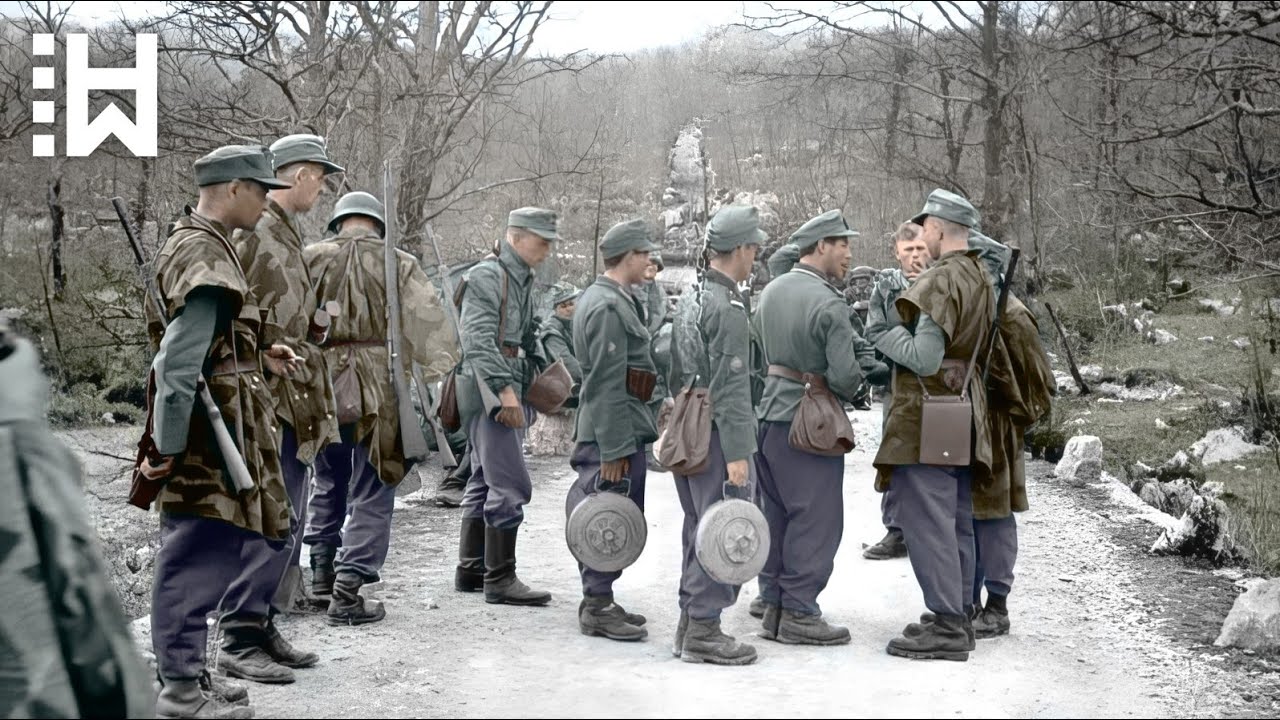
They wore the prestigious Edelweiss flower on their uniforms.
They were celebrated as Germany’s mountain warriors.
Highly trained.
Disciplined.
Elite.
But behind the heroic image lay a far darker reality.
By the end of World War II, the men of Germany’s 1st Mountain Division had become some of the most feared killers in occupied Europe.
Entire villages disappeared wherever they marched.
Women were executed.
Children were burned alive.
And thousands of innocent civilians paid the ultimate price.
THE ELITE UNIT THAT BECAME A MACHINE OF TERROR
When World War II erupted in September 1939, the 1st Mountain Division entered Poland as one of Germany’s most respected military formations.
Nearly 25,000 soldiers marched beneath the symbol of the Edelweiss flower.
To Nazi propaganda, they were heroes.
To many civilians, they would soon become executioners.
Even during the invasion of Poland, members of the division were already accused of murdering civilians and prisoners of war.
It was only the beginning.
FROM THE EASTERN FRONT TO THE DEPTHS OF BRUTALITY
Everything changed in June 1941.
Hitler launched Operation Barbarossa.
The invasion of the Soviet Union.
The largest and bloodiest front of the war.
Here the soldiers of the 1st Mountain Division entered a world of unimaginable violence.
Prisoners were starved.
Civilians were treated as enemies.
Mass shootings became routine.
In occupied cities, Jews were hunted, beaten, and murdered.
The brutality transformed many of the men who survived.
They returned from the Eastern Front hardened by violence and increasingly indifferent to human suffering.
THE FLAG ON EUROPE’S HIGHEST PEAK
In 1942, the division advanced deep into the Caucasus Mountains.
At one point, German troops climbed Mount Elbrus, the highest mountain in Europe.
There they planted the Nazi flag on the summit.
German newspapers celebrated the achievement as proof of Hitler’s unstoppable power.
But while cameras captured the victory, disaster was already approaching.
Soon Soviet counterattacks shattered German dreams of conquest.
Thousands of mountain troops died.
Others retreated through snow, hunger, and chaos.
The survivors emerged even more ruthless than before.
THE VILLAGE THEY TURNED INTO AN INFERNO
In 1943, the division was transferred to the Balkans.
Officially, they were fighting resistance fighters.
In reality, entire civilian populations became targets.
One of the most horrifying atrocities occurred in the Albanian village of Borovë.
German soldiers armed with flamethrowers surrounded the settlement.
Homes were set ablaze.
Villagers were trapped.
Families fled in panic.
Many never escaped.
Some victims were herded into the village church.
Then the building was burned.
The people inside died in the flames.
THE MASSACRE OF MOUSIOTITSA
Only weeks later, the division struck again.
This time in Greece.
On July 25, 1943, soldiers surrounded the village of Mousiotitsa.
The victims were not soldiers.
They were farmers.
Shepherds.
Mothers.
Children.
The elderly.
Villagers were rounded up and marched to a plateau.
Then machine guns opened fire.
136 civilians were slaughtered.
So many died that survivors could not dig enough graves.
Bodies were dumped into a dry well.
Later, German reports falsely claimed the victims were “bandits.”
THE VILLAGE OF CHILDREN
The bloodshed continued.
On August 16, 1943, the division attacked Kommeno.
The result was one of the worst massacres in occupied Greece.
317 civilians were murdered.
Among them were pregnant women.
Grandparents.
And 94 children under the age of 15.
Entire families vanished within hours.
The village became a graveyard.
REVENGE AGAINST THE INNOCENT
The division’s cruelty reached another horrifying peak in October 1943.
After partisans killed a German officer, soldiers descended on the village of Lingiades.
The victims had nothing to do with the attack.
That did not matter.
92 civilians were executed.
Most were women and children.
Homes were burned.
Only five people survived by pretending to be dead among the corpses before escaping through chimneys as buildings burned around them.
THE MASSACRE OF THEIR OWN ALLIES
Then came one of the division’s most infamous crimes.
Italy had surrendered.
Former allies suddenly became enemies.
On the Greek island of Kefalonia, thousands of Italian soldiers laid down their weapons.
They expected to become prisoners of war.
Instead, many were executed.
Over several days, approximately 5,200 Italian soldiers were massacred.
Men who had fought alongside Germany were suddenly treated as disposable.
OVER 200 VILLAGES DESTROYED
By the end of 1943, the numbers were staggering.
More than:
- 200 villages destroyed
- 4,500 homes burned
- At least 2,000 civilians murdered
And all while only a handful of German soldiers had been killed in combat during the same period.
These were not battles.
They were massacres.
THE FALL OF THE EDELWEISS
As Germany collapsed, the once-proud mountain division disintegrated.
Its survivors retreated through Yugoslavia, Hungary, and Austria.
The men who once conquered mountains were now fleeing for their lives.
When the war ended in May 1945, thousands surrendered to Allied forces.
JUSTICE FINALLY ARRIVES
Some perpetrators never lived to see judgment.
Others were hunted down after the war.
Several officers were executed.
Others received prison sentences.
One by one, many of those responsible faced consequences for the atrocities committed across Europe.
FROM HEROES TO MONSTERS
The story of the 1st Mountain Division remains one of the darkest transformations of World War II.
A unit created to conquer mountains.
A unit celebrated as elite warriors.
A unit that became associated with burned villages, mass executions, and the murder of civilians.
The Edelweiss flower they proudly wore was once meant to symbolize courage and honor.
But for countless victims in Poland, Ukraine, Greece, Albania, and Yugoslavia, it came to symbolize something entirely different:
Fear.
Terror.
And death.
Today, the memorials at Mousiotitsa, Kommeno, Lingiades, Borovë, and countless other villages stand as reminders of what happened when one of Hitler’s elite military units turned its weapons not against armies…
…but against innocent men, women, and children.
