April 1945.
Bergen-Belsen concentration camp.
When British and Canadian forces entered Bergen-Belsen, they expected a prisoner camp.
What they found looked closer to the end of civilization itself.
Tens of thousands of corpses lay unburied across the mud.
Children wandered alone beside piles of bodies.
Survivors, barely alive, collapsed from hunger, typhus, and exhaustion.
The smell of death covered the camp.
Nothing the soldiers had seen during the war prepared them for this.
But the horror did not come only from starvation and disease.
It also came from the people who enforced terror every single day.
Including the women.
THE CAMP THAT BECAME A MASS GRAVE
Although Bergen-Belsen was not originally built as an extermination camp, conditions inside eventually became catastrophic.
By the final months of the war:
- overcrowding exploded
- food supplies collapsed
- sanitation disappeared
- typhus spread uncontrollably
Nearly 35,000 prisoners died in just the last months before liberation.
And even after liberation, thousands more would die because their bodies were already too destroyed to recover.
THE FEMALE GUARDS OF BELSEN
Among the SS personnel were women transferred from camps like:
- Ravensbrück concentration camp
- Auschwitz II-Birkenau
Some had once worked ordinary jobs:
- shop assistants
- servants
- nurses
- farm workers
Inside the camp system, many transformed into brutal enforcers.
Witnesses later described guards who:
- beat starving prisoners
- used dogs to attack inmates
- conducted selections
- humiliated the sick and dying
THE “HYENA OF AUSCHWITZ”
The most infamous among them was:
Irma Grese.
Born in 1923, Grese suffered a traumatic childhood marked by her mother’s suicide when she was only 13 years old.
At 18, she volunteered for service at Ravensbrück.
By 1943, she had arrived at Auschwitz.
And by 1944, she held one of the highest positions available to female guards.
Survivors accused her of:
- whipping prisoners
- unleashing dogs on inmates
- participating in gas chamber selections
- beating women to death
She became known as:
“The Hyena of Auschwitz”
“The Beautiful Beast”
THE WOMAN WITH THE DOG
Another feared guard was:
Johanna Bormann.
Originally a domestic servant and animal caretaker, Bormann became notorious for patrolling camps with a trained German Shepherd.
Witnesses testified she ordered the dog to attack prisoners repeatedly.
Even in the final starving months of Bergen-Belsen, survivors described her continuing violent punishments against weakened inmates.
THE SUPERVISOR OF THE WOMEN’S SECTION
Then there was:
Elisabeth Volkenrath.
A former Ravensbrück guard who rose through the camp system before being transferred to Auschwitz and later Bergen-Belsen.
Although witnesses did not always describe her as openly sadistic as Grese, testimony linked her directly to:
- selections for the gas chambers
- brutal punishments
- denial of medical assistance
By the final year of the war, she had become one of the key female supervisors inside the women’s camp.
THE GIANTESS OF BELSEN
Herta Bothe also became infamous among prisoners.
Tall and physically imposing, survivors nicknamed her:
“The Giantess of Belsen.”
Witnesses testified she carried a wooden stick and brutally beat prisoners who collapsed from exhaustion or failed to move quickly enough.
Unlike Grese and Volkenrath, however, Bothe avoided execution.
She received a prison sentence and was eventually released in the early 1950s.
THE GUARD WHO ADMITTED HER GUILT
One unusual figure was:
Herta Ehlert.
Unlike many defendants, Ehlert openly admitted during interrogation that she had beaten prisoners and used force.
She attempted to justify her behavior as maintaining “discipline,” but her testimony still helped expose the internal structure of violence inside the camps.
She received 15 years in prison but served far less after postwar amnesties.
THE KITCHEN WORKER WHO CONTROLLED FOOD
Not every perpetrator carried a whip openly.
Irene Haschke worked in the camp kitchen.
But inside Bergen-Belsen, food itself was power.
Witnesses testified she denied starving prisoners extra food, beat inmates searching for scraps, and helped enforce the system of hunger that dominated camp life.
Even smaller roles contributed directly to suffering and death.
THE BRITISH DISCOVERED A HUMANITARIAN CATASTROPHE
After liberation on April 15th, 1945, British forces faced chaos beyond anything they had anticipated.
Typhus spread everywhere.
Medical supplies were insufficient.
Many liberated prisoners died after eating regular military rations because their bodies could no longer digest heavy food.
Between 13,000 and 14,000 additional prisoners reportedly died in the weeks after liberation due to disease, starvation damage, and treatment mistakes.
THE SS GUARDS FORCED TO BURY THE DEAD
British troops immediately forced captured SS personnel to collect corpses and bury them in mass graves.
The guards worked:
- without protection
- under armed supervision
- surrounded by the same horror they had overseen
Some later died from typhus themselves.
THE BELSEN TRIALS
Five months later came the:
Belsen Trial.
One of the first major war crimes trials after World War II.
The proceedings exposed:
- starvation policies
- beatings
- dog attacks
- selections
- systematic abuse
Film footage from Bergen-Belsen was shown publicly as evidence — one of the first major uses of recorded visual evidence in a war crimes trial.
THE EXECUTIONER OF THE THIRD REICH’S FALL
British executioner:
Albert Pierrepoint
was tasked with carrying out many of the death sentences.
At:
Hamelin Prison
he supervised the executions of numerous convicted camp personnel between 1945 and 1949.
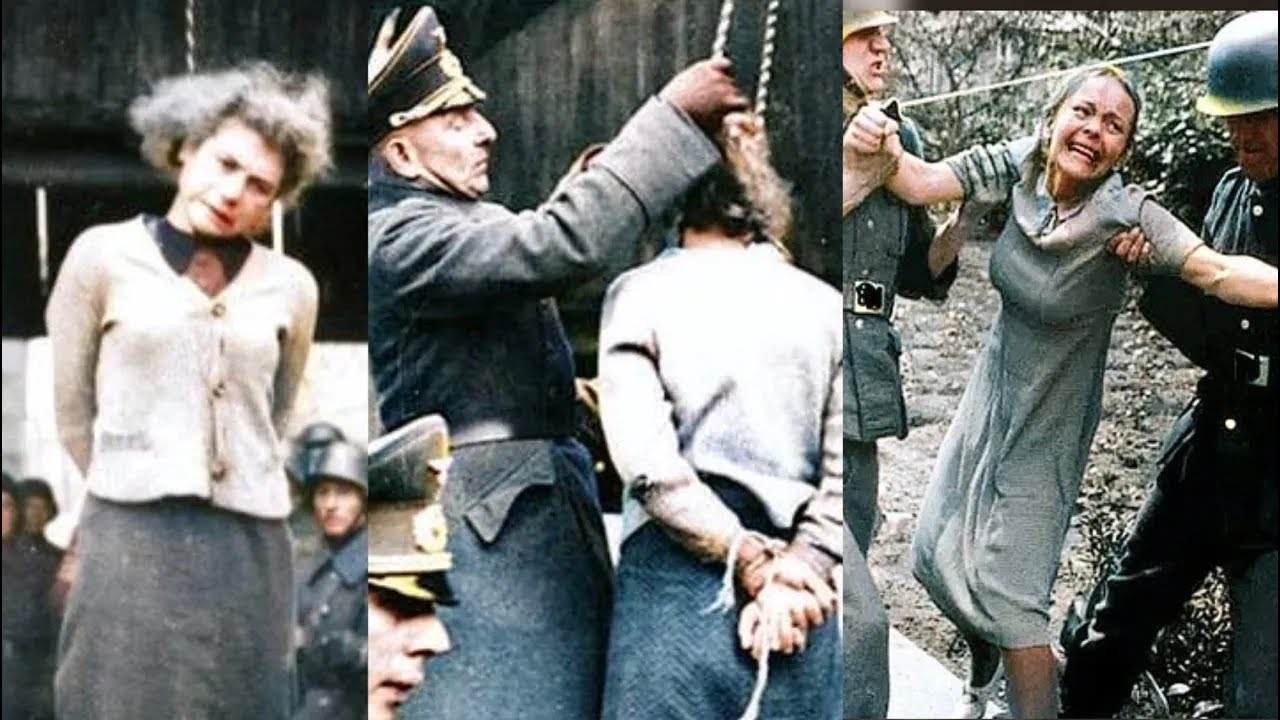
On December 13th, 1945, he hanged:
- Irma Grese
- Johanna Bormann
- Elisabeth Volkenrath
- and multiple male camp officials including Josef Kramer, the commandant of Bergen-Belsen
THE WOMAN WHO SAID “QUICKLY”
According to reports, as Irma Grese approached the gallows she spoke only one final word:
“Schnell.”
(“Quickly.”)
Moments later, the trapdoor opened.
She was 22 years old.
One of the youngest Nazi war criminals executed after the war.
THE REVENGE AFTER LIBERATION
Not all justice came through courts.
After liberation, enraged prisoners attacked some former kapos and collaborators inside the camp.
Years of starvation, humiliation, and terror erupted into spontaneous revenge.
British forces struggled to restore order while simultaneously fighting disease and mass death.
THE CAMP THAT BECAME A WARNING TO THE WORLD
Photographs and films from Bergen-Belsen shocked the world permanently.
The images proved that the concentration camps were not rumors or propaganda.
They were real.
And the women standing inside them were real too.
Some were executed.
Others served prison terms.
Some eventually disappeared quietly back into ordinary life.
But Bergen-Belsen left behind one terrifying lesson:
Mass cruelty does not depend only on dictators or famous leaders.
Sometimes it also depends on ordinary people willing to enforce suffering day after day…
…until horror itself becomes routine.
