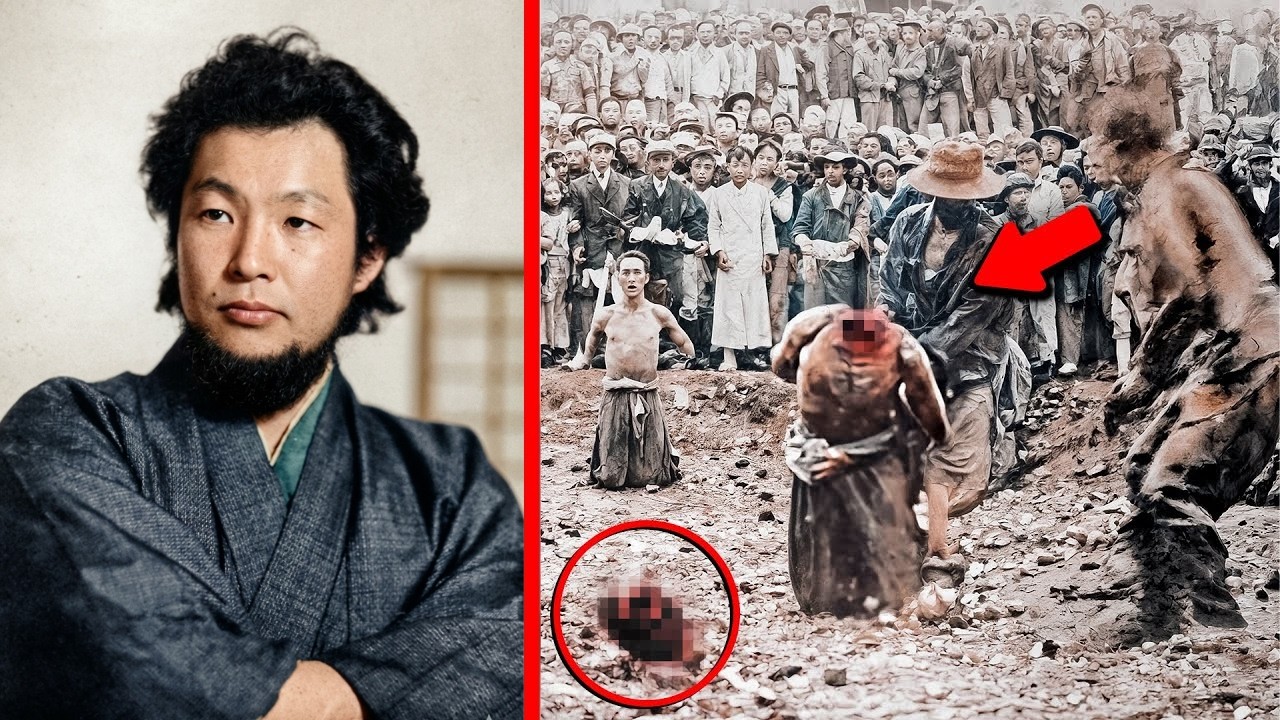
January 28th, 1948.
Yuhuatai, Nanjing.
A cold wind swept across the execution ground as three former Japanese officers were marched through the dirt under armed guard.
One of them could barely stand.
Years earlier, he had walked through Nanjing carrying a sword with terrifying confidence.
Now his hands were tied behind his back.
His empire was gone.
His army destroyed.
And the survivors of the city he helped terrorize were watching him take his final steps toward death.
His name was Gunkichi Tanaka.
An Imperial Japanese Army captain whose name became permanently linked to one of the darkest atrocities of the 20th century:
The Rape of Nanking.
THE YOUNG OFFICER RAISED TO BELIEVE MERCY WAS WEAKNESS
Gunkichi Tanaka was born in Japan during the early 1900s as the empire was rapidly militarizing.
From childhood, young Japanese officers were taught a brutal ideology:
- absolute loyalty to the emperor
- surrender was shameful
- mercy was weakness
Tanaka absorbed all of it.
He entered the Imperial Japanese Army as a young man and steadily climbed the ranks.
By the mid-1930s, he had become a captain and company commander inside the Imperial Army’s 6th Division — a formation that would later become infamous across China.
To his superiors, Tanaka was disciplined and aggressive.
To the soldiers under him, he was feared.
A commander who believed brutality made men stronger.
THE ROAD TO NANKING
In 1937, full-scale war erupted between Japan and China.
The Japanese advance inland was fast, violent, and relentless.
Chinese defenses collapsed city after city as Imperial troops pushed toward the Chinese capital of Nanking.
According to the account, discipline inside many Japanese units began breaking down during the advance.
Officers looked the other way.
Soldiers were taught the enemy was less than human.
And commanders like Tanaka were given enormous freedom to operate however they wished.
WHEN KILLING BECAME PUBLIC ENTERTAINMENT
As Japanese forces moved toward Nanking, disturbing stories appeared in newspapers back home.
Two officers — Toshiaki Mukai and Tsuyoshi Noda — reportedly competed to see who could kill 100 people first using only a sword.
The Japanese press covered the killings almost like a sporting event.
Scores were updated.
Photographs printed.
Readers followed the contest the way modern audiences follow celebrity gossip.
It became one of the clearest signs of how completely human life had collapsed in value inside sections of the invading army.
Tanaka was not one of those two officers.
But according to later investigations, he traveled the same blood-soaked roads carrying his own sword — and building a reputation even darker.
THE FALL OF NANKING
Nanking fell on December 13th, 1937.
What followed over the next six weeks became one of the most infamous massacres in modern history.
Hundreds of thousands of Chinese civilians and surrendered soldiers were trapped inside the city.
Foreign missionaries and diplomats created an international safety zone to shelter refugees.
But outside those protected areas, mass violence exploded.
Witnesses described:
- executions of prisoners
- mass rape
- looting
- torture
- civilians murdered street by street
Historians estimate roughly 300,000 people may have died during the massacre.
THE OFFICER ACCUSED OF PERSONALLY KILLING HUNDREDS
According to records later presented before the Nanjing War Crimes Tribunal, Tanaka personally participated in mass killings inside the city.
The figure associated with his case stunned investigators:
More than 300 unarmed civilians and prisoners allegedly killed by a single officer using his sword.
The tribunal concluded these were not battlefield killings.
Not acts of self-defense.
But repeated executions carried out deliberately over an extended period of time.
Investigators cited:
- survivor testimony
- captured Japanese documents
- wartime records
- postwar witness statements
According to the prosecution, Tanaka was not a man swept away by chaos.
He was an officer who actively embraced it.
THE EMPIRE THAT PROTECTED HIM
Perhaps the most disturbing detail was that Tanaka reportedly showed little shame during the massacre itself.
He returned to his tent after killings.
Ate meals normally.
Issued orders the next morning.
Then allegedly repeated the violence again and again.
Inside the culture of the Imperial Army at that moment, brutality was often rewarded rather than punished.
THE HUNT AFTER JAPAN’S SURRENDER
Everything changed in 1945.
After Japan surrendered, Allied investigators began tracking officers linked to atrocities across Asia.
The Nanking Massacre became one of the highest priorities.
Chinese authorities demanded the arrest of officers associated with the slaughter.
Gunkichi Tanaka quickly appeared near the top of the wanted lists.
By 1947, American occupation forces had arrested him in Japan and transferred him to Sugamo Prison.
Then came the moment that must have shattered him psychologically:
He was extradited back to Nanking itself.
The very city where the killings occurred.
The very streets where survivors still lived.
THE COURTROOM OF NANKING
The Nanking War Crimes Tribunal had been established by China’s Nationalist government to prosecute Japanese war criminals.
Tanaka stood trial alongside Mukai and Noda — the same officers connected to the infamous “100-man killing contest.”
The evidence against him was overwhelming.
Witness testimony.
Captured wartime records.
Survivor accounts.
Photographs.
Military documentation.
The judges concluded that Tanaka’s actions were not accidental wartime excesses.
They were deliberate acts of murder.
The sentence:
Death.
THE FINAL CIGARETTES
On January 28th, 1948, Tanaka, Mukai, and Noda were transported under guard to Yuhuatai — a historic hill outside Nanking chosen as the execution site.
A surviving photograph from that morning shows the three condemned officers sitting together smoking what would become their final cigarettes.
Gone was the arrogance they once carried into China.
According to Chinese accounts, when the moment came to walk toward the execution site, the men could barely move on their own.
The officers who once treated human beings as disposable reportedly had to be guided and supported toward their own deaths.
THE FIRING SQUAD AT YUHUATAI
The execution itself was swift and official.
Chinese soldiers raised their rifles.
Tanaka was 42 years old.
Within seconds, gunfire echoed across Yuhuatai.
The officer who had once walked through Nanking carrying his sword like a symbol of power collapsed into the dirt beside the other condemned men.
Their bodies were reportedly buried in unmarked locations to prevent future nationalist shrines from being created.
THE WARNING HISTORY NEVER FORGOT
Gunkichi Tanaka was not a famous prime minister.
Not a legendary field marshal.
Not one of the highest-ranking leaders of Imperial Japan.
He was a captain.
One officer among thousands.
And that is precisely why historians continue discussing him.
Because his story demonstrates how ordinary men — shaped by militarism, propaganda, dehumanization, and unchecked violence — can become participants in atrocities on an unimaginable scale.
The Nanking Massacre killed an estimated 300,000 people.
Tanaka was only one small piece of that machinery.
But the evidence against him became so overwhelming that history could no longer look away.
And on a freezing morning in January 1948, the city that had watched him arrive with a sword finally watched him leave under rifle fire instead.
