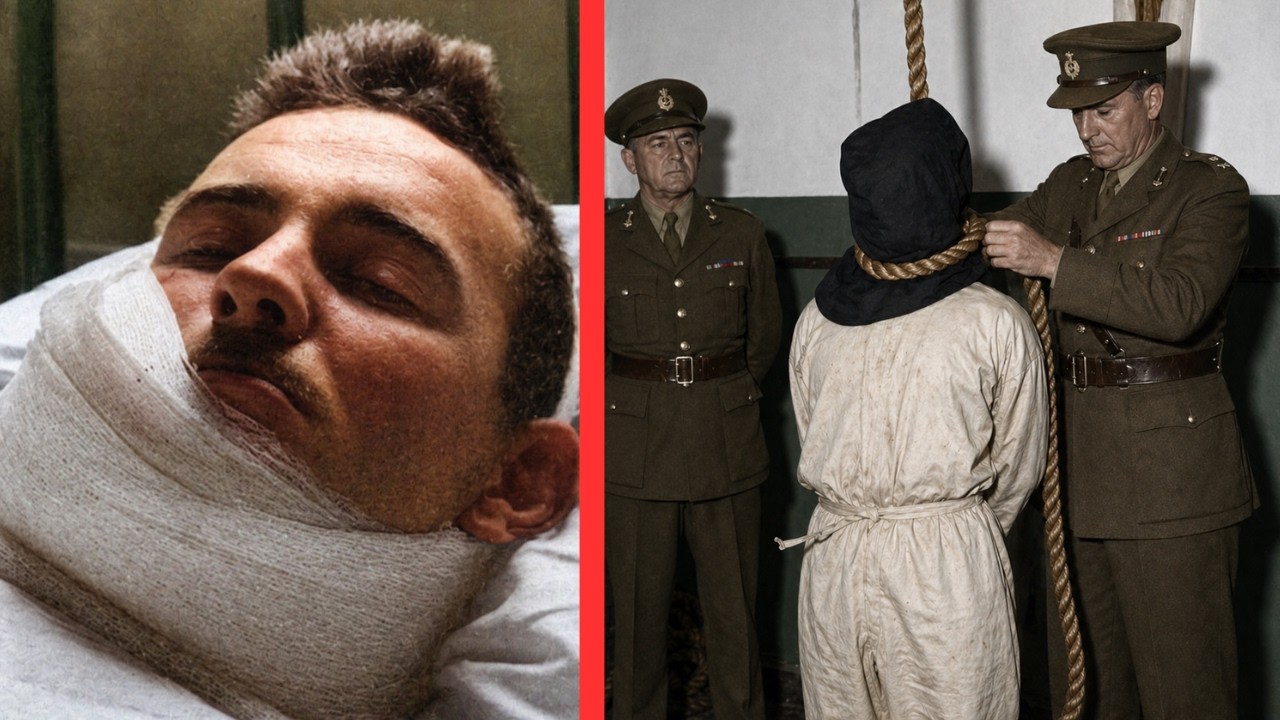
January 3rd, 1946.
Wandsworth Prison, London.
A man known across Britain simply as “Lord Haw-Haw” was led toward the gallows.
For years, millions had heard his voice crackling through wartime radios late at night.
Mocking Britain.
Predicting defeat.
Trying to destroy morale while bombs fell across London.
Now the voice that once terrified wartime listeners had fallen silent.
And the British government wanted to send a message to the world:
This man was not a soldier.
He was a traitor.
THE MAN WHO BETRAYED BRITAIN USING PROPAGANDA
William Joyce — later infamous as “Lord Haw-Haw” — was born in Brooklyn, New York, in 1906 but later lived in Ireland and England.
From a young age, he embraced extreme right-wing politics.
By the 1930s, he had joined the British Union of Fascists led by Oswald Mosley.
Joyce quickly became known for his powerful speaking ability.
Sharp voice.
Aggressive speeches.
Theatrical delivery.
Those talents would later make him one of Nazi Germany’s most notorious propagandists.
THE FASCIST WHO FLED TO HITLER’S GERMANY
As war approached in 1939, Joyce feared arrest in Britain because of his fascist activities.
So he fled to Nazi Germany.
Once there, he began working directly for Joseph Goebbels’ propaganda machine, broadcasting radio programs aimed at British audiences.
It was during these broadcasts that British listeners gave him the mocking nickname:
“Lord Haw-Haw.”
The name referred to his exaggerated upper-class accent.
But behind the ridicule, many officials considered him dangerous.
THE VOICE THAT ENTERED BRITISH HOMES DURING THE BLITZ
During World War II, Joyce’s broadcasts became infamous across Britain.
He mixed accurate information about bomb damage and military events with psychological warfare.
He exaggerated British losses.
Predicted collapse.
Claimed defeat was inevitable.
Millions listened — some out of curiosity, others out of fear.
For the British government, however, Joyce represented something deeply personal:
A man who understood Britain…
…and used that knowledge to attack it from inside Nazi Germany.
THE PROPAGANDIST HUNTED AFTER THE FALL OF THE THIRD REICH
In 1945, Nazi Germany collapsed.
William Joyce tried to flee once again.
British forces eventually captured him near the Danish border.
According to reports, Joyce reached into his pocket as officers approached, causing them to believe he was armed.
He was shot and wounded before soldiers realized his identity.
Soon afterward, he was transported back to Britain to stand trial.
THE LEGAL CASE THAT SHOCKED BRITAIN
The trial of William Joyce immediately became controversial.
One major question dominated the courtroom:
Could he legally commit treason against Britain if he had actually been born an American citizen?
Joyce’s lawyers argued he was not truly British.
But prosecutors focused on one critical detail:
Joyce had obtained a British passport by falsely claiming British nationality.
The prosecution argued that by accepting British protection through the passport, he also owed allegiance to the Crown.
The court agreed.
THE MAN ACCUSED OF GIVING “AID AND COMFORT TO THE ENEMY”
Joyce was charged with high treason for aiding Nazi Germany through propaganda broadcasts during wartime.
His trial at the Old Bailey attracted enormous public attention.
For many Britons, this was not simply a legal proceeding.
It was revenge against the voice they had heard during some of the darkest nights of the Blitz.
The jury found him guilty.
The sentence:
Death.
WHY BRITAIN REFUSED TO SHOOT HIM
Many countries traditionally executed wartime enemies by firing squad.
So why was William Joyce hanged instead?
Because Britain wanted to deny him any military honor.
A firing squad implied a soldier.
A combatant.
Someone punished under military law.
The British government refused to give Joyce that status.
By executing him on the gallows, they sent a clear message:
He was not a warrior.
He was a criminal traitor.
HANGING WAS RESERVED FOR CRIMINALS
Under British law at the time, treason remained a capital offense punishable by hanging.
Centuries earlier, traitors had suffered horrific punishments like drawing and quartering.
By the 20th century, those methods had been replaced by the “long drop” hanging technique designed to break the neck quickly.
The symbolism still mattered.
Hanging was associated with murderers and criminals — not soldiers.
And Britain wanted Joyce remembered exactly that way.
THE FINAL WALK TO THE GALLOWS
On January 3rd, 1946, William Joyce was led into the execution chamber at Wandsworth Prison.
The executioner waiting for him was Albert Pierrepoint — Britain’s most experienced hangman, later responsible for executing numerous Nazi war criminals.
The procedure was swift.
The noose tightened around Joyce’s neck.
The trapdoor opened.
The drop snapped his neck almost instantly.
The man whose voice had once echoed across wartime Europe was dead within seconds.
WHY THE EXECUTION BECAME SYMBOLIC
For Britain, Joyce’s death represented more than punishment for one man.
It symbolized the line between patriotism and betrayal.
Between fighting in war…
…and exploiting war for ideology and propaganda.
Executing him through civilian law rather than military execution reinforced Britain’s claim that even after World War II, justice would still follow legal procedure rather than mob vengeance.
THE TRAITOR WHO TURNED WORDS INTO WEAPONS
Historians still debate parts of Joyce’s case today.
Especially whether the legal reasoning about nationality and allegiance was fully sound.
But few dispute the effect his broadcasts had on wartime Britain.
His voice entered British homes during bombings, blackouts, and fear.
And for many listeners, that betrayal felt uniquely personal.
In the end, Britain chose the gallows over the firing squad for one reason above all:
William Joyce was never meant to die as a soldier.
He was meant to die as a traitor.
