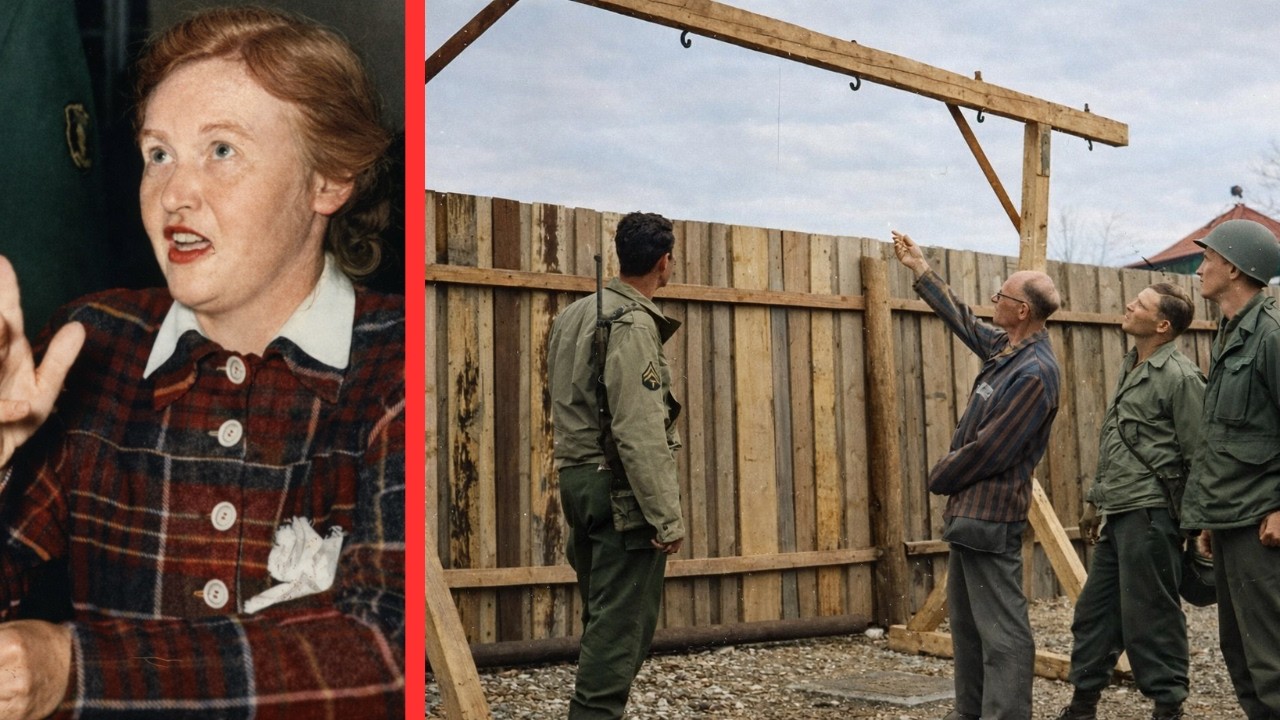
She was one of the most feared women connected to Nazi Germany’s concentration camp system — a woman whose name became synonymous with cruelty, sadism, and horror.
To the world, she became known as:
“The Witch of Buchenwald.”
Stories about her spread across newspapers after World War II like wildfire. Survivors described a glamorous SS wife who rode through concentration camps on horseback carrying a whip, humiliating prisoners while living in luxury above a landscape of starvation and death.
Some accused her of crimes so horrifying they sounded almost impossible to believe.
Human skin lampshades.
Tattooed body parts turned into souvenirs.
Prisoners selected to die simply because she enjoyed their suffering.
Whether every rumor was true or not, one thing became undeniable:
Ilse Koch became one of the most infamous women of the Third Reich.
And in the end, her life would end alone inside a prison cell with a bedsheet around her neck.
THE ORDINARY WOMAN WHO ENTERED THE NAZI MACHINE
Ilse Koch was born Ilse Margarete Köhler in Dresden, Germany, on September 22nd, 1906.
Nothing about her early life suggested she would become a symbol of Nazi terror. She grew up in what was considered an ordinary, respectable German family and trained as a bookkeeper and secretary.
But Germany in the early 1930s was collapsing into chaos.
Economic disaster, political violence, and humiliation after World War I pushed millions toward extremist movements promising order and national revival.
In 1932, Ilse joined Adolf Hitler’s Nazi Party.
Soon afterward, she met the man who would transform her life forever:
Karl Otto Koch, a brutal SS officer rising rapidly through the Nazi concentration camp system.
The two married in 1936.
Not long afterward, Karl Koch became commandant of Buchenwald concentration camp near Weimar, Germany.
THE VILLA OVERLOOKING HELL
Buchenwald opened in 1937 and quickly became one of the largest concentration camps inside Nazi Germany.
Tens of thousands of prisoners passed through its gates. Many died from starvation, disease, forced labor, torture, or execution.
While prisoners suffered below, Ilse Koch lived comfortably with her husband in a luxurious villa overlooking the camp.
But according to survivors, she did not stay isolated from the horrors beneath her window.
Witnesses later claimed she frequently rode horseback through the camp carrying a riding crop or whip. Prisoners described her humiliating inmates, ordering punishments, and sometimes participating in beatings herself.
One former inmate later described the fear prisoners felt simply hearing her approach.
Then came the rumors that made her internationally infamous.
THE HUMAN SKIN ALLEGATIONS THAT SHOCKED THE WORLD
After the war, horrifying stories emerged from Buchenwald.
Witnesses accused Ilse Koch of selecting prisoners with unusual tattoos so their skin could allegedly be removed after death and turned into objects such as lampshades or book covers.
Newspapers exploded with sensational headlines.
The accusations transformed her into a monster in the public imagination and cemented her terrifying nickname:
“The Witch of Buchenwald.”
But historians later questioned parts of these stories.
Investigators struggled to prove several of the most shocking allegations, and some details were likely exaggerated during the chaotic years immediately after the war.
Even so, evidence strongly suggested that Ilse Koch had personally abused prisoners and actively participated in the brutal culture of Buchenwald.
THE SS EXECUTED HER OWN HUSBAND
Meanwhile, Karl Koch’s crimes were attracting attention from inside the Nazi regime itself.
But not because of cruelty.
Because of corruption.
SS investigators discovered that Karl Koch had been stealing valuables and money confiscated from prisoners rather than handing them over to the Nazi state.
The SS leadership became furious.
In a stunning twist, the Nazis arrested one of their own concentration camp commandants. After an internal SS trial, Karl Koch was sentenced to death and executed by firing squad in April 1945 — only days before American troops liberated Buchenwald itself.
Ilse Koch was also arrested during the investigation but later released.
Her freedom would not last long.
THE TRIAL THAT MADE HER WORLD FAMOUS
In April 1945, American forces liberated Buchenwald and uncovered evidence of horrifying crimes inside the camp.
Soon afterward, Ilse Koch was arrested again by the U.S. Army. Survivors eagerly testified against her, and newspapers across Europe and America turned her into one of the most infamous women connected to Nazi war crimes.
In 1947, she stood trial before an American military court during the Buchenwald Trials.
Witness after witness described cruelty, abuse, torture, and the atmosphere of terror inside the camp.
The stories about tattooed skin dominated international headlines.
To much of the public, Ilse Koch became the female face of concentration camp evil.
At the end of the trial, she received a life sentence.
But then came a shocking controversy.
THE SENTENCE THAT CAUSED INTERNATIONAL OUTRAGE
In 1948, American military governor General Lucius D. Clay reviewed the case.
Clay believed there was insufficient evidence proving some of the most extreme accusations — especially the claims involving lampshades made from human skin.
He reduced Ilse Koch’s sentence to only four years in prison.
The reaction was explosive.
Newspapers condemned the decision across both Europe and the United States. Many people believed one of Nazi Germany’s most notorious women had escaped justice.
Public outrage became so intense that West German authorities arrested her again in 1950.
This second trial focused less on sensational rumors and more on direct evidence of abuse, cruelty, and incitement to murder. Former prisoners testified that she ordered punishments, beatings, and brutal labor assignments that led to deaths.
In January 1951, Ilse Koch was once again sentenced to life imprisonment.
This time, she would never leave prison alive.
THE LONELY DEATH OF THE “WITCH OF BUCHENWALD”
During her years behind bars, Ilse Koch gave birth to a son conceived during her earlier imprisonment after the war.
The child was eventually raised by foster parents.
Meanwhile, Koch spent years insisting she was innocent.
She claimed she had become a symbol onto which the world projected the horrors of Nazism. But the courts had already reached their conclusions, and public hatred toward her never disappeared.
By the 1960s, her physical and mental condition had deteriorated badly.
Then, on the night of September 1st, 1967, prison guards made a grim discovery inside her Bavarian prison cell.
Ilse Koch had hanged herself using a bedsheet.
She was 60 years old.
THE WOMAN WHO BECAME A SYMBOL OF CONCENTRATION CAMP HORROR
Even decades after her death, Ilse Koch remains one of the most infamous women associated with Nazi Germany.
Historians still debate some of the more sensational stories attached to her name, especially the allegations involving human skin objects.
But there is little doubt that she belonged to the brutal world of Buchenwald — a place where tens of thousands suffered and died beneath the Nazi concentration camp system.
Her story remains one of the darkest examples of how ordinary people could become deeply involved in a system built on cruelty, terror, and mass suffering.
