A woman whose name became synonymous with the depths of Nazi cruelty has died by her own hand in a Bavarian prison cell. Ilse Koch, infamously known as “The Witch of Buchenwald,” was found dead at age 60, ending a decades-long legal saga that saw her twice convicted for her brutal actions at the concentration camp where her husband served as commandant. Prison guards discovered her body on the night of September 1, 1967; she had used a bedsheet to hang herself. Her death closes one of the most disturbing chapters in the history of Nazi war crimes, yet the debate over her precise atrocities continues to this day.
 Born Ilse Margarete Köhler in Dresden in 1906, her early life was unremarkable. She trained as a bookkeeper and, like many Germans drawn to promises of national revival, joined the Nazi Party in 1932. Her fate changed irrevocably when she met and married Karl Otto Koch, an SS officer with a reputation for brutality and corruption. His appointment as commandant of Buchenwald concentration camp in 1937 placed the couple at the heart of the Nazi terror apparatus.
From their comfortable villa overlooking the camp, Ilse Koch did not remain a distant observer. Survivor testimonies consistently described her frequent, menacing presence within the camp grounds, often on horseback and carrying a whip. Prisoners reported she took pleasure in selecting inmates for punishment, ordering beatings, and humiliating those she encountered. Her notoriety, however, reached global infamy from allegations that she collected tattoos from murdered prisoners.
Post-war witnesses claimed she had inmates with distinctive tattoos killed so their skin could be tanned and fashioned into macabre souvenirs like lampshades and book covers. These stories, widely reported in sensational detail, cemented her terrifying nickname and made her a focal point for Allied prosecutors seeking justice. Her husband, meanwhile, was executed by the SS itself in April 1945 for corruption, just days before American forces liberated Buchenwald.

Arrested by the U.S. Army, Ilse Koch stood trial in 1947 during the subsequent Buchenwald trials. The proceedings captivated an international audience horrified by the descriptions of camp life and the specific, ghastly accusations against her. She was found guilty and sentenced to life imprisonment, a verdict that seemed to deliver long-awaited justice. That judgment was shockingly short-lived.
In 1948, U.S. Military Governor General Lucius D. Clay reviewed the case and controversially reduced her sentence to four years, citing insufficient forensic evidence for the most sensational claims involving human skin artifacts. The decision provoked immediate and fierce outrage on both sides of the Atlantic, viewed as an appalling leniency toward a central figure of camp brutality.
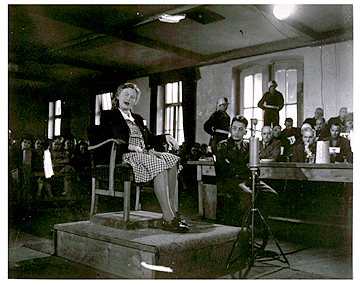
Bowing to immense public pressure, West German authorities rearrested and tried her in 1950. This second trial focused less on unverifiable horrors and more on her documented abuse of power and incitement to murder. Based on overwhelming survivor testimony, the court found her guilty of severe cruelty and again sentenced her to life imprisonment. This time, the sentence stood.
She would spend the remainder of her days in Aichach women’s prison, a figure of enduring infamy. In prison, she gave birth to a son who was placed with a foster family. She maintained her innocence in frequent letters, arguing she had been made a scapegoat for the regime’s evils. Historians now agree that some of the most extreme tales about her were likely exaggerated in the post-war chaos, lacking concrete proof.

Nevertheless, the historical consensus is clear: Ilse Koch was an active and willing participant in the brutal environment of Buchenwald. She wielded arbitrary power over the lives of prisoners in a system where tens of thousands perished from starvation, disease, and execution. Her life exemplifies how ordinary individuals became complicit in extraordinary evil.
Her suicide brings a stark end to a story that forced the world to confront the specific cruelty women could perpetrate within the Nazi system. While the precise details of her crimes may be debated, her legacy as “The Witch of Buchenwald” remains inextricably tied to the camp’s horrors. The memory of the suffering at Buchenwald, and her role within it, endures as a grim lesson in the human capacity for barbarity.
