Milan, Italy – April 28, 1945. The lifeless body of deposed Fascist dictator Benito Mussolini was strung upside down from a half-built service station in a Milanese square, subjected to a final, brutal spectacle of public vengeance. This grotesque display, captured in photographs that would shock the world, marked the ignominious end of a man who had ruled Italy with an iron fist for more than two decades.
 The events unfolded with grim speed following his execution. Mussolini and his mistress, Clara Petacci, were shot by partisans near Lake Como earlier that day. Their bodies, along with those of other executed Fascist leaders, were transported by truck to the Piazzale Loreto in Milan. By 3 a.m., the corpses were dumped unceremoniously on the ground at a site heavy with symbolic resonance for the partisan resistance.
A crowd gathered swiftly, transforming into a seething mob of thousands. For a population enduring years of war, repression, and Nazi collaboration, the corpse became a focal point for pent-up rage. Witnesses described a scene of chaotic fury. Civilians spat on the bodies, kicked them, and hurled stones. One woman fired five pistol shots into Mussolini’s corpse, screaming a tribute to her murdered sons.
“He died too quickly,” others cried out. The hatred was visceral and often wordless, a raw release of collective trauma. The body of the former Duce, clad in a militia uniform, was battered beyond recognition, his skull pierced by bullets. This uncontrolled outburst was not orchestrated by partisan authorities but was undeniably permitted, a cathartic moment in a fractured nation.
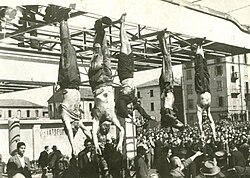
To prevent the complete destruction of the bodies and to make them visible to the swelling crowd, partisans hoisted them up. Mussolini, Petacci, and others were hanged upside down from the metal girders of an Esso gas station under construction. This act, while seemingly an escalation of the violence, also served to elevate the corpses above the immediate reach of the mob.
The inverted hanging was a deliberate and profoundly symbolic act of posthumous humiliation. In Italian and broader European tradition, displaying a body upside down represents the ultimate disgrace and moral condemnation. It visually signified the complete overturning of Mussolini’s power, prestige, and authority. The once-boastful strongman was now a powerless, degraded spectacle.
The location was meticulously chosen for its historical weight. On August 10, 1944, the very same square witnessed a Nazi atrocity. Fifteen Italian partisans and civilians were executed there by the Gestapo and their bodies left on public display. Mussolini was alleged to have coldly remarked, “For the blood of the Piazzale Loreto, we shall pay dearly.” The treatment of his corpse was widely seen as grim repayment for that debt.

Politically, the macabre exhibition served a crucial purpose. With Italy unstable and emerging from civil war, partisan leaders feared Fascist sympathizers might attempt to reclaim Mussolini’s body, creating a martyr’s shrine. Publicly displaying his mutilated remains shattered any lingering mystique. It provided undeniable proof of his death and served as a stark, brutal warning against any resurgence of the Fascist ideology he embodied.
International reaction to the circulating photographs was one of profound shock. Allied leaders and foreign journalists expressed concern that the spectacle appeared barbaric and vindictive, undermining the moral high ground of the liberation. Within Italy, however, opinion remained sharply divided. Many citizens saw it as just, if brutal, retribution for the years of oppression, disastrous war, and alliance with Hitler’s Germany.
 Others viewed it as a troubling descent into the very mob violence and dehumanization they had fought to overthrow. The event forced a painful national introspection about justice, vengeance, and the legacy of a brutal regime. It starkly illustrated the violent rupture between Italy’s past and its uncertain future.
The ordeal of Mussolini’s corpse had a direct and chilling impact hundreds of miles away in Berlin. News of the dictator’s fate, including the mutilation and humiliation of his body, reportedly reinforced Adolf Hitler’s resolve to avoid capture at all costs. Days later, on April 30, he committed suicide in his Führerbunker, ensuring his own body would not become a similar trophy.
Benito Mussolini, who had risen to power through staged shows of force and who used public intimidation as a key tool of governance, met an end that was itself a horrific public performance. The image of his inverted corpse remains one of the most enduring and unsettling icons of World War II’s conclusion, a visceral symbol of a regime’s total collapse and the furious reckoning it provoked.
The body was later cut down under American orders. A subsequent autopsy confirmed death by gunshot, with multiple wounds near the heart. Mussolini’s remains would enter a decades-long odyssey, hidden, stolen, and fought over, before finally being interred in his family crypt in Predappio in 1957—a contested resting place for a dictator whose final, shameful exposure had forever seared his downfall into history.
