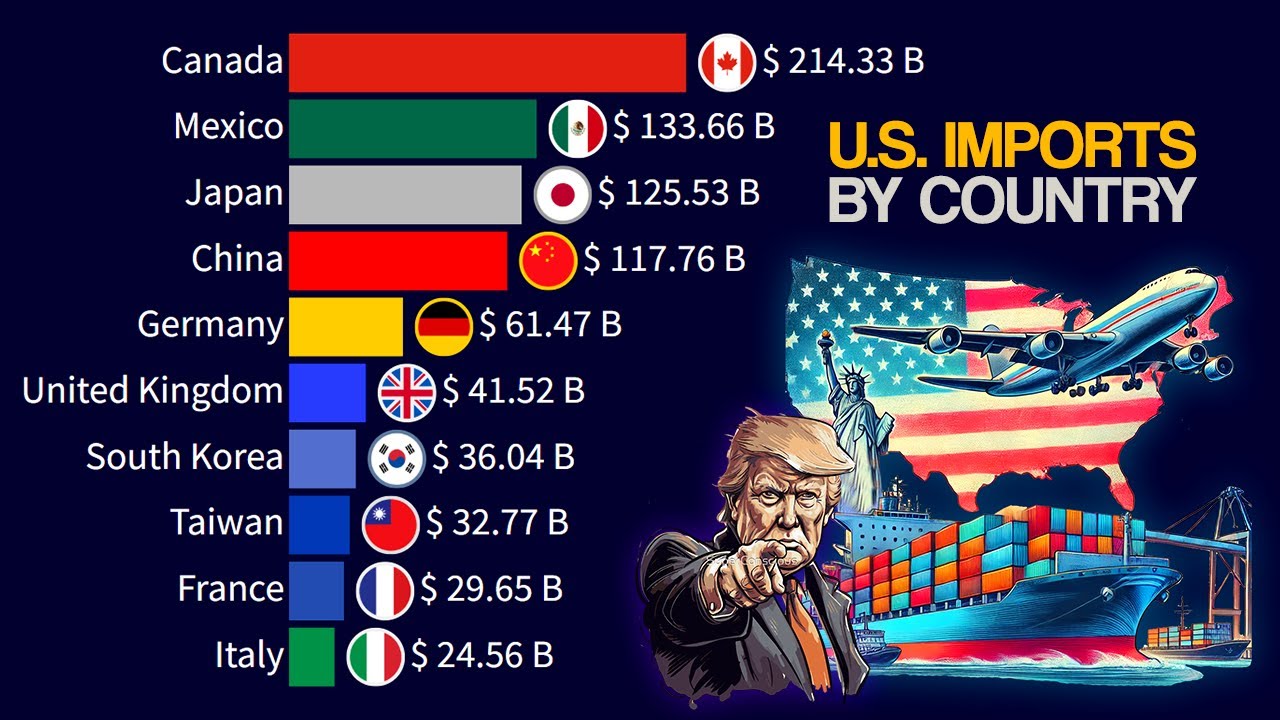
For four decades, the United States import landscape has reflected not only consumer demand, but the rise and fall of global economic powerhouses. From the factories of Asia to the trading blocs of Europe and North America, the U.S. has remained the world’s largest importer — and its choices reveal much about how the world has changed since 1985.
Let’s explore the transformation of U.S. imports by country of origin, tracing how global supply chains, politics, and innovation reshaped America’s trade relationships.
📦 1985–1999: Japan’s Dominance & NAFTA’s Birth
In the late 1980s, Japan was the second-largest economy in the world — and a dominant U.S. trading partner. American streets were flooded with Japanese cars, electronics, and precision tools.
Meanwhile, Canada and Mexico were rising trade partners due to proximity and the signing of NAFTA (1994), which began to shape a unified North American trade zone.
Top sources of imports in the late 1990s:
-
🇯🇵 Japan
-
🇨🇦 Canada
-
🇩🇪 Germany
-
🇲🇽 Mexico
-
🇰🇷 South Korea
🌏 2000–2010: The China Boom
The 2000s marked a seismic shift in global trade. After joining the WTO in 2001, China rapidly became the largest supplier of goods to the U.S.
-
Low labor costs and aggressive manufacturing policy made China the “world’s factory.”
-
Electronics, textiles, toys, and later smartphones flooded into U.S. ports.
-
By 2009, China had surpassed Canada as the U.S.’s top import source.
Top import partners in 2010:
-
🇨🇳 China
-
🇨🇦 Canada
-
🇲🇽 Mexico
-
🇯🇵 Japan
-
🇩🇪 Germany
🔄 2011–2020: Globalization & Trade Wars
The 2010s brought more complexity:
-
China’s lead widened, but U.S.-China tensions flared under the Trump administration.
-
Tariffs and trade disputes from 2018 onward shifted some sourcing to Vietnam, India, and other Asian economies.
-
Mexico quietly rose, thanks to reshoring efforts and automotive manufacturing growth.
The U.S.-Mexico-Canada Agreement (USMCA) replaced NAFTA in 2020, reinforcing regional trade.
By 2020, imports from:
-
🇨🇳 China (still #1, but slipping)
-
🇲🇽 Mexico (rising fast)
-
🇨🇦 Canada
-
🇯🇵 Japan
-
🇩🇪 Germany
-
🇻🇳 Vietnam (breaking into top 10)
📈 2021–2025: Diversification, Supply Chain Shifts & Friend-Shoring
The COVID-19 pandemic and post-pandemic recovery reshaped global trade:
-
Supply chain disruptions led U.S. companies to diversify away from China.
-
Vietnam, India, Malaysia, and Thailand gained share in apparel, electronics, and machinery.
-
Mexico benefitted from a surge in nearshoring, especially in automotive and electronics.
-
By 2025, China remains a top supplier, but its share has declined from its peak.
Top import sources in 2025 (estimated):
-
🇲🇽 Mexico
-
🇨🇳 China
-
🇨🇦 Canada
-
🇻🇳 Vietnam
-
🇩🇪 Germany
-
🇮🇳 India
-
🇯🇵 Japan
-
🇰🇷 South Korea
-
🇮🇹 Italy
-
🇹🇭 Thailand
